Sign in. It’s quick, free and it’s up to you.
An account is an optional way to support the work we do. Find out more.
Sign in. It’s quick, free and it’s up to you.
An account is an optional way to support the work we do. Find out more.
A REAL-LIFE INCIDENT in which a man was nearly sucked out the window of a Ryanair flight when it “detached” mid-air appears to have been the basis of a fake story featuring AI-generated images.
The passenger, a 61-year-old tourist from Serbia on a flight from Greece to Germany who had been pulled back inside the plane by other passengers, was hospitalised with friction burns but was otherwise in good condition, witnesses and officials have said.
Greek media reported the incident had occurred on 10 July over North Macedonia, and said the window had been broken by a piece of debris that detached from one of the plane’s engines.
However, the following day, an almost identical story appeared on social media sites, though with major details changed.
The story also involves a 61-year-old Ryanair passenger being partly sucked out of a window mid-flight, but with his wife clinging to his legs to keep him from being pulled out. In this version of the story, the couple were flying from Liverpool to Dublin when disaster struck.
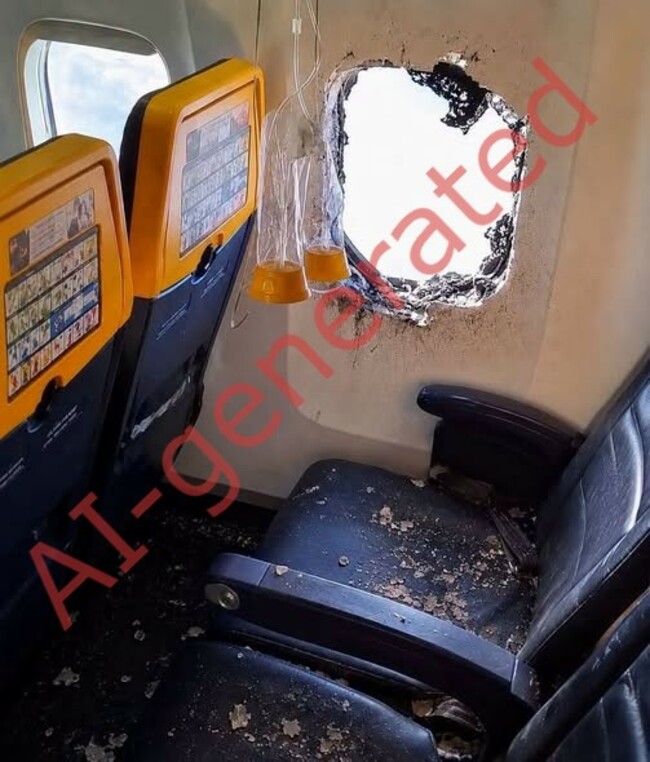
These posts are also accompanied by AI-generated images purportedly showing the aftermath of the event.
These are similar to real images from the aftermath of the Greece-to-Germany flight, though some details are noticeably different, such as the height of the dropped air masks, additional damage to the plane’s hull in the AI image, and a different, now-visible, internal structure around the damaged windows of craft.
However, using a tool provided by AI company, OpenAI, a “SynthID” was found on the image. The SynthID is an invisible, digital watermark purposely added by some AI image generators so that their creations can be readily identified.
While the real-life incident occurred in Greek airspace, authorities in Greece said that the ongoing investigation had been handed over to a US agency for transportation safety.
With reporting from PA & AFP
The Journal’s FactCheck is a signatory to the International Fact-Checking Network’s Code of Principles. You can read it here. For information on how FactCheck works, what the verdicts mean, and how you can take part, check out our Reader’s Guide here. You can read about the team of editors and reporters who work on the factchecks here.

To embed this post, copy the code below on your site












have your say